Category Archives: songs/poetry

swimming

This seems the perfect poem to ruminate on as I’m headed out the door for a morning swim (especially that last stanza).  There have been times in my life when swimming was the most important thing I could do–I’m thinking of the night after I learned that my father had terminal cancer.  I swam 100 laps then, despite being 8 months pregnant.  Swimming until I’d lost every ounce of strength left in me.  Because I thought I could swim away the hurt and the reality of what was happening…

And one more thing: I’m looking for a local who’d like to do some ocean swimming with me. If you’re interested, drop me a line.

The Swimming Lesson
by Mary Oliver

Feeling the icy kick, the endless waves
Reaching around my life, I moved my arms
And coughed, and in the end saw land.

Somebody, I suppose,
Remembering the medieval maxim,
had tossed me in,
Had wanted me to learn to swim,

Not knowing that none of us, who ever came back
From that long lonely fall and frenzied rising,
Ever learned anything at all
About swimming, but only
How to put off, one by one,
Dreams and pity, love and grace,–
How to survive in any place.

when you hear that unmistakable pounding…

IMG_5233

West Wind #2

You are young.
So you know everything.
You leap into the boat and begin rowing.
But listen to me.
Without fanfare, without embarrassment,
without any doubt,
I talk directly to your soul.
Listen to me.
Lift the oars from the water,
let your arms rest,
and your heart,
and heart’s little intelligence,
and listen to me.

There is life without love. It is not worth a bent
penny, or a scuffed shoe. It is not worth the body of a
dead dog nine days unburied. When you hear, a mile
away and still out of sight, the churn of the water
as it begins to swirl and roil, fretting around the
sharp rocks – when you hear that unmistakable
pounding – when you feel the mist on your mouth
and sense ahead the embattlement, the long falls
plunging and steaming – then row, row for your life
toward it.

~ Mary Oliver ~

sea-legs

reflection
I went to the beach last week to chase the setting sun, but I was wearing my bionic leg so I couldn’t even dip in a toe to the water (for fear of shorting out my circuitry).  Such an ache I felt to leave leg and clothes in a heap on the beach and just swim…

The Mary Oliver poem below, especially the first stanza, reminds me of the day a few years ago when I received the pathology pictures from the hospital where I had my cancer treatments–including the images of my amputated limb.  It was tougher than I thought it would be to look at those images, and afterwards I went for a long swim.  As I let the water support me I ‘felt’ my leg there with me, for the first time in a long while.  It was a powerful moment to reconnect with something that I’d lost and mourned for so many years, my body truly re-membering itself as I moved through the water…

And this poem also reminds me of how I struggle against gravity, where every step can be a huge effort…and how I long for the ocean–knowing that at sea is where I feel more free and comfortable (and alive) than I ever do on land.

The Sea
by Mary Oliver

Stroke by
stroke my
body remembers that life and cries for
the lost parts of itself–

fins, gills
opening like flowers into
the flesh–my legs
want to lock and become
one muscle, I swear I know
just what the blue-gray scales
shingling
the rest of me would
feel like!
paradise! Sprawled
in that motherlap,
in that dreamhouse
of salt and exercise,
what a spillage
of nostalgia pleads
from the very bones! how
they long to give up the long trek
inland, the brittle
beauty of understanding,
and dive,
and simply
become again a flaming body
of blind feeling
sleeking along
in the luminous roughage of the sea’s body,
vanished
like victory inside that
insucking genesis, that
roaring flamboyance, that
perfect
beginning and
conclusion of our own.

but what I think of now…


A selection from:

Eve on Her Deathbed

Linda Pastan

In the end we are no more than our own stories:
mine a few brief passages in the Book,
no further trace of plot or dialogue.
But I once had a lover no one noticed
as he slipped through the pages, through
the lists of those begotten and begetting.
Does he remember our faltering younger selves,
the pleasures we took while Adam,
a good bureaucrat, busied himself
with naming things, even after Eden?
What scraps will our children remember of us
to whom our story is simple
and they themselves the heroes of it? …
But what I think of now,
in the final bitterness of age,
is the way the garden groomed itself
in the succulent air of summer—each flower
the essence of its own color; the way even
the serpent knew it had a part it had to play, if
there were to be a story at all.

guilty pleasures…

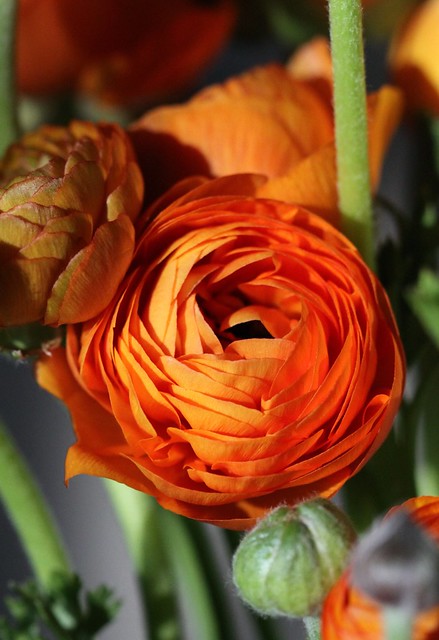
ranunculus
One of my favorite guilty pleasures is perusing the poetry and interviews in The Paris Review.  I don’t remember how or why I began reading it, but once I did I was hooked.  Recently I was going through some poetry in the online archives and came across this interview with writer Shirley Hazzard.  I especially enjoy what she says about poetry:

Poetry has been the longest pleasure of my life. It literally and figuratively saved my life, and enabled me to live inwardly. I do not know how people manage without it…

Vladimir Nabokov told his American students that they must saturate themselves in the poetry of their language, poetry in English, in order to develop the ear. This seems to me the most valuable advice one could give to readers or writers. Of course, he did not mean that this should be done with a “purpose” in mind, as if to exploit the power and beauty of great art. Accessibility to expressive language will not come that way. It is an act of love, with implicit humility, and must develop itself. So much of this is intuitive, and intuition itself must be developed from an early age if it is not to languish. Our era of interpretations and explanations and the piling up of convoluted lingo in the academic world–the self-gratification of many a “close reading,” the psycho-sociological overlaying and, often, undermining that commentators apply to works of genius–has been inimical to the nurturing of intuitive affinity and understanding. Much of that arises, I think, from a modern fear of immediacy and of the loss of the illusion of control. Housman’s reference to the hairs rising at the back of one’s neck as one reads a poem remains a test of quality. Such response is individual and cannot merely be generalized, dismantled, controlled.

I love that feeling of “the hairs rising at the back of one’s neck” from poetry.  I know that sensation all too well.  And it’s what keeps me coming back for more.

and it seemed at once they’d fallen in love…

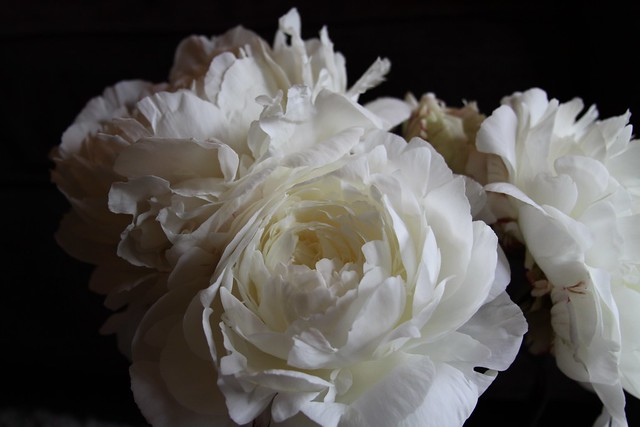
IMG_4282

I came upon these white peonies at the market yesterday, their heads nearly as big as my own and their fragrance so potent. They found their way into my basket and into my living room (and into my viewfinder)…The poem below is a favorite from a dear friend, one that I’ve had pinned on the bulletin board in my kitchen for quite a long time.

Peonies

Heart transplants my friend handed me:

four of her own peony bushes

in their fall disguise, the arteries

of truncated, dead wood protruding

from clumps of soil fine-veined with worms.

“Better get them in before the frost.”

And so I did, forgetting them

until their June explosion when

it seemed at once they’d fallen in love,

had grown two dozen pink hearts each.

Extravagance, exaggeration,

each one girl on her first date,

excess perfume, her dress too ruffled,

the words he spoke to her too sweet–

but he was young; he meant it all.

And when they could not bear the pretty

weight of so much heart, I snipped

their dew-sopped blooms; stuffed them in vases

in every room like tissue boxes

already teary with self-pity.

~Mary Jo Salter

a great lover…

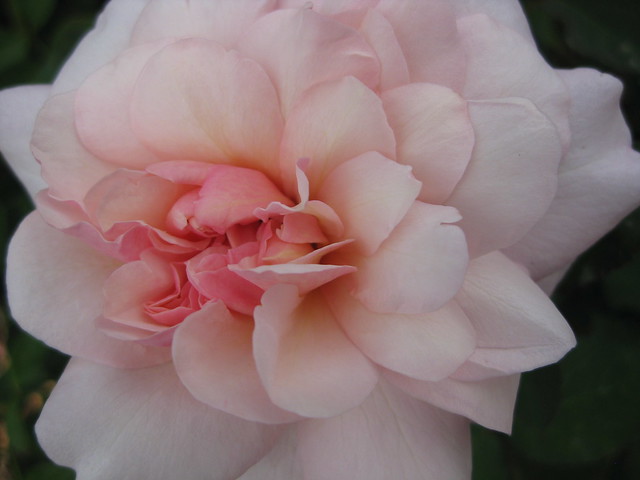
pale pink rose

A friend shared the poem below on my Facebook page recently, and it literally left me breathless as I read (note: I’ve made a few changes here to make it a bit more female-positive).

A few days ago I was having a thoughtful chat with another friend and it struck me how hard my life has often been–in that I’ve had to bend and alter my path because of situations beyond my control.  So many of my wishes and desires are unfulfilled.  There are so many ‘what ifs’ to my life that I simply can’t pursue because of circumstance.  But despite this, I feel as though I’ve surrendered myself to these restrictions and found even more freedom through doing so.  In large part, I think my ability to surface from a morass is because I simply love life so much, and I find huge pleasure in the smallest of things.  Perhaps that’s the result of having survived so much already, or perhaps it’s simply my nature.  I don’t know.  But it makes me feel buoyant and strong.

The Great Lover
by Rupert Brooke

I have been so great a lover: filled my days
So proudly with the splendour of Love’s praise,
The pain, the calm, and the astonishment,
Desire illimitable, and still content,
And all dear names [wo]men use, to cheat despair,

For the perplexed and viewless streams that bear
Our hearts at random down the dark of life.
Now, ere the unthinking silence on that strife
Steals down, I would cheat drowsy Death so far,
My night shall be remembered for a star

That outshone all the suns of all [wo]men’s days.
Shall I not crown them with immortal praise
Whom I have loved, who have given me, dared with me
High secrets, and in darkness knelt to see

The inenarrable god[dess]head of delight?

Love is a flame;—we have beaconed the world’s night.
A city:—and we have built it, these and I.

An emp[ress]:—we have taught the world to die.
So, for their sakes I loved, ere I go hence,
And the high cause of Love’s magnificence,
And to keep loyalties young, I’ll write those names
Golden for ever, eagles, crying flames,
And set them as a banner, that [wo]men may know,
To dare the generations, burn, and blow
Out on the wind of Time, shining and streaming….
These I have loved:
White plates and cups, clean-gleaming,
Ringed with blue lines; and feathery, faery dust;
Wet roofs, beneath the lamp-light; the strong crust
Of friendly bread; and many-tasting food;
Rainbows; and the blue bitter smoke of wood;
And radiant raindrops couching in cool flowers;
And flowers themselves, that sway through sunny hours,
Dreaming of moths that drink them under the moon;
Then, the cool kindliness of sheets, that soon
Smooth away trouble; and the rough male kiss
Of blankets; grainy wood; live hair that is
Shining and free; blue-massing clouds; the keen

Unpassioned beauty of a great machine;

The benison of hot water; furs to touch;
The good smell of old clothes; and other such—
The comfortable smell of friendly fingers,
Hair’s fragrance, and the musty reek that lingers
About dead leaves and last year’s ferns….
Dear names,
And thousand others throng to me! Royal flames;
Sweet water’s dimpling laugh from tap or spring;
Holes in the ground; and voices that do sing:
Voices in laughter, too; and body’s pain,
Soon turned to peace; and the deep-panting train;
Firm sands; the little dulling edge of foam
That browns and dwindles as the wave goes home;

And washen stones, gay for an hour; the cold

Graveness of iron; moist black earthen mould;
Sleep; and high places; footprints in the dew;
And oaks; and brown horse-chestnuts, glossy-new;
And new-peeled sticks; and shining pools on grass;—
All these have been my loves. And these shall pass.
Whatever passes not, in the great hour,
Nor all my passion, all my prayers, have power
To hold them with me through the gate of Death.
They’ll play deserter, turn with the traitor breath,
Break the high bond we made, and sell Love’s trust

And sacramented covenant to the dust.
—Oh, never a doubt but, somewhere, I shall wake,
And give what’s left of love again, and make

New friends, now strangers….
But the best I’ve known,

Stays here, and changes, breaks, grows old, is blown
About the winds of the world, and fades from brains
Of living [wo]men, and dies.
Nothing remains.

O dear my loves, O faithless, once again
This one last gift I give: that after [wo]men
Shall know, and later lovers, far-removed
Praise you, “All these were lovely”; say, “[S]he loved.”

dropping from the veils of the morning…

It’s a quiet morning, the members of my household all working in different tasks.  Working together, but separate.  There’s the sound of a neighbor’s friendly conversation that can be faintly heard through the window.  The cawing of crows outside the front of our home is not so faint.  But there are songbirds, too.  And an occasional motorcycle or loud-ish car passing.  There’s the tinkle of Ellycat’s bell as she wanders from room to room looking for a warm lap.  And the living room is full of soft morning light.

A few days ago, Catgirl asked me about my synesthesia, specifically curious about the types of sensory cross-over that I experience.  I don’t have the common variety of text-to-visual synesthesia.  Rather, I have visual-to-sound and touch-to-visual.  I explained to her that it’s why I can find it so difficult to shop in a mall or in an unfamiliar grocery store–the ‘loud’ designs of the displays create a tornado of sound in my head.  It’s hard to process so much visual-sound all at once.  It makes me want to find a dim quiet place to sit down and close my eyes. But, on the other hand, if I’m somewhere like an art museum and can take time to savor each painting, the result is far more melodic.

Lately, I’ve found that images with rich brown-grey colors are yielding such peaceful-quiet tones in my mind.  There’s something about their softness that makes me breathe a little deeper and feel more relaxed.  It’s almost beyond description, the way my mind makes sounds from images–so I don’t know if this makes any sense at all to someone who hasn’t experienced it.  It’s similar to the way I feel when I read some poetry, such as the classic “Lake Isle of Innisfree.”

Here are some of my recent favorite “quiet” photos:

[flickrslideshow acct_name=”pilgrimgirl” id=”72157626821277615″]

The Lake Isle of Innisfree
By William Butler Yeats
I will arise and go now, and go to Innisfree,
And a small cabin build there, of clay and wattles made;
Nine bean rows will I have there, a hive for the honeybee,
And live alone in the bee-loud glade.

And I shall have some peace there, for peace comes dropping slow,
Dropping from the veils of the morning to where the cricket sings;
There midnight’s all a-glimmer, and noon a purple glow,
And evening full of the linnet’s wings.

I will arise and go now, for always night and day
I hear lake water lapping with low sounds by the shore;
While I stand on the roadway, or on the pavements gray,
I hear it in the deep heart’s core.

we need more worlds…

IMG_2255

Religious Consolation

by John Updike

One size fits all. The shape or coloration
of the god or high heaven matters less
than that there is one, somehow, somewhere, hearing
the hasty prayer and chalking up the mite
the widow brings to the temple, A child
alone with horrid verities cries out
for there to be a limit, a warm wall
whose stones give back an answer, however faint.

Strange, the extravagance of it—who needs
those eighteen-armed black Kalis, those musty saints
whose bones and bleeding wounds appall good taste,
those joss sticks, houris, gilded Buddhas, books
Moroni etched in tedious detail?
We do; we need more worlds. This one will fail.