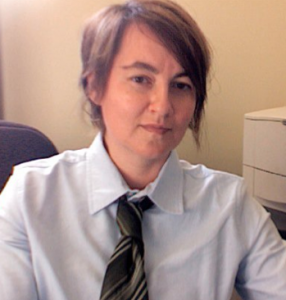
Me, at work
Tonite’s post finds me snuggled in on the couch. I’m sneezy right now, and my glands are swollen. That’s probably far more than you wanted to know about me, but this post is going to have a bit more TMI than my usual, so I thought I’d just get warmed-up from the get-go….
For quite some time now I’ve been meaning to follow up on my #genderd experiment. At the close of that day, one of the things I realized was that I never tweeted about using the bathroom. And I should have. It’s one of the most explicitly gendered choices I make several times per day at the office. I work on the floor of a building that has two restrooms. They are both single stalls with locked doors. One has signage for men, and one for woman. Or at least, they did back on September 1st when I did my #genderd experiment. But shortly after that day, I received an email from Chapman University’s SafeSpace Committee saying that they were working to locate all single-stall bathrooms on campus and change them from an assigned-sex bathroom to a gender-neutral bathroom. So I replied to them about the ones on my floor and suggested that the change would be particularly welcome because the floor primarily has women’s offices, so there can often be a line for the women’s bathroom, but I’ve never seen any men waiting in line for their designated stall. And honestly I thought many times about just using the men’s stall myself–given that it had a locking door, what would be the harm in doing so? But because I still felt so new at my job and I felt too uncomfortable to push the social boundary of using the opposite-sex bathroom stall in front of my colleagues. So I didn’t.
When I returned from my trip last week I discovered new signage on the men’s stall. It now has a men/women/wheelchair sign, while the women’s bathroom stall signage stayed the same. I think that’s peculiar, but I haven’t yet written to the the campus sign-maker to see why both stalls weren’t given the same signs. But perhaps what’s more interesting, are the surprised looks on the faces I’ve seen when I use the now-gender-neutral stall. After I exit that door I’ve seen colleagues walk up very close to the sign as if to see if it’s “real.” I’ve only seen one other woman ever use it, and she wasn’t a regular on our floor.
While I think having one neutral stall on the floor is certainly progress, I still think it would be far better to have two neutral stalls. Because it seems that as long as there is a women’s stall, the other stall will be “not women’s.” However, it could be that the reason they kept one as women’s is that it includes the wastebin at the side of the toilet for “hygiene” products (what a janitor friend of mine affectionately called the “cigar box”), and the formerly-men’s bathroom doesn’t have that feature. I’ve also noticed each time I use the not-women’s restroom that the toilet seat has been left up. I’m going to guess that that’s a leftover from when it was a “men’s” stall only.
And…speaking of men…
Last week I had the strangest concurrence of experiences. By the third time it happened I was so rattled, I could hardly make my way back to the place where I was staying for the night…
Three times in three days I had men call me out in public space, yelling sex-laden obscenities. What is probably most bizarre about this experience is that I’ve never had a man even so much as whistle my direction before (unless, perhaps, it was my partner being playful). Catcalls from strangers seemed like something that happened to streetwalkers and not to women that look like me. I suppose I’ve never experienced this because I don’t often walk in urban spaces–I’ve tended to live in middle-class suburban areas. But I also suspect that women who are disabled are far less likely to garner attention from male strangers.
The third time this happened I was alone and in a fairly deserted area of a city where I knew I probably shouldn’t be walking at night. But I was hungry and there was a corner store a few blocks away. I was sure I’d be just fine. And I was. But having a group of men following behind me and hurtling obscenities my way as I walked down the block? I was so scared. What was I scared of? Scared, knowing that I couldn’t run if they came after me. Scared, because I didn’t think I could dial anything coherent on my cellphone of they neared. Scared, because there was no one else nearby to hear if I should scream. Looking back on it now, it’s possible that these men might’ve even thought that they were flattering me with their opinions about my body. Perhaps they thought that I would respond back playfully or provocatively. But I think they knew that what they were doing was cruel and that I was scared shitless, despite my attempt to walk even more tall and confidently down the block as the vulgarity continued.
There was nothing in my clothing or in my behavior that indicated that I would be a target for men’s attention. I have a “boy” haircut, I’m nearly 40 years old. I was not wearing makeup and I was wearing “Mom” jeans (read: not sexy). But I was identifiably female, still, which is why I suppose I was a target.
I deliberately choose to raise my kids in an upper-middle-class neighborhood where just about anyone can safely walk at night. Though there are occasionally some college rowdy college students around, there is little to fear in my environment. There are, of course, costs to living in such a homogeneous suburban community, and lately I’ve wondered if we haven’t veered towards being too “safe” in choosing a place to live. For example, I relish the vibrancy of the urban neighborhoods that I found on recent travels through Oakland, San Francisco, and in San Diego, and felt the contrast to our “vanilla” community quite keenly. And while I usually don’t feel that I fit in my neighborhood (I am not really a vanilla gal, myself), it would be hard for me to change now if it meant facing the kind of jeering that I experienced last week on a regular basis. I suppose I would get used to it–perhaps even expect it. But it’s hard for me to imagine that now, I suspect I might just always be afraid.





When I received this ritual, it didn’t occur to me to remove my artificial limb. Most likely that was due to the fact that I wouldn’t have been ambulatory without it, and also because I was not sure exactly what the “rules” were about such things and no one clarified them for me (for the most part, these rituals are not explained beforehand, due to their sacred nature). Since then I’ve learned that women with breast prosthetics can choose to wear them during the ritual. I’ve never heard any definitive word on the wearing of artificial limbs, but I suspect that it is allowable.
Because of the staging of this ritual, it was not evident to the recipients that I was wearing an artificial leg until it was nearly completed, when the officiant bent down in front of me to bless my legs (while I was seated on a throne-chair). After undergoing the washing and anointing a few times, I learned to catch the gaze of the officiant as she reached out to touch my not-real leg. There was often a pause. Usually a knowing glance was exchanged between us as she continued on with the script of the ritual (were she to speak words other than those prescribed, the ritual would be deemed ineffective and would have to be repeated according the prescribed pattern).
In the moments after the ritual, as we waited for me to be escorted by an officiant to the next step in the process, there was often a moment for some whispered conversation. Usually the officiant would mention something about my leg, asking how did I lose it, or commenting that my prosthesis looked very lifelike (which was back in the day before I chose to let my robotic innards hang out).
Those ritual moments, are, for me, emblematic of how I view my relationship to my prosthetic leg. It seems as much a part of me as my tongue, or my eyes, or my liver. That I take it off at night and lay it next to my bed, doesn’t make it any less “me.” That it is a thing of metal and plastic and vinyl, doesn’t make it any less familiar than my other leg and foot. That it sometimes makes an audible whirring adjustment sound when I walk through quiet spaces, is no different than the familiar creaks of my organic joints. That its parts are fabricated from components that come from all over the globe, and are assembled by workers in Germany and are fitted to my body by men in Orange County, doesn’t make it any less me. Perhaps what makes it feel the most ‘foreign’ is the attention that my leg garners as I move through public space. It is the reaction of others that reminds me that I am different.
I suppose that being a cyborg comes “naturally” to me. I couldn’t live my life normally without the microprocessor in my knee, or the metal crutches that I use when I’m not wearing my prosthetic. These tools are so much a part of my life that they are my life. They are familiar in the same way that my hands are on my keyboard. I don’t think each time I type that I am sending letters from my fingertips to the screen and out to you. I just do it. Like that, I just walk. And stand. And move. The way that I do.
*Note: recently there were some changes to this ritual that include less physical interaction between officiant and recipient, and also how much clothing is removed beforehand. I am discussing how it worked back in 1992, when I first participated.