Category Archives: deep thoughts

learning to…breathe (again)

pink flower photoToday was the first official day of my summer sabbatical.  My goals for this time period are legion and include many plans for writing, reading, relaxing, reconnecting, and letting some of the stresses of this past year roll off of my shoulders.

But my largest goal is to stretch, everyday.

My shoulders and hips and legs are so tight that I’ve been in nearly-constant pain for the past 4 months.  I’ve had too many hours at my desk, too many hours commuting by car.  And when I have been exercising, it’s generally been a power activity like canoeing or rock climbing, and not an activity that increases my limberness.

So today: yoga.

Gentle restorative stretches to ease the tightness in my lower back.  It’s humbling to realize how far I’ve drifted from my previous, flexible self.  And things weren’t going so well with the yoga stretching (ouch) until I realized that I’d forgotten to breathe. My jaw was still clenched tight, my mind remained focused on some stressors that I can’t control.  My hands were tight fists.

So I stoked the coals in my belly and started to send the heat out to my aching muscles.

Inhaling and exhaling from deep inside.

And it worked.  I got looser (a bit).  I stretched for an hour and then I spent my 10 minutes of shavasana focusing solely on breathing.  When I sat up afterwards, the pain was definitely decreased, and I felt more alert, more hopeful, and more ready for what lies ahead.


home(less)

dorm

The Middle Earth dorms at UCI, where I first lived when I moved to Irvine.

“I have learned that if you must leave a place that you have lived in and loved and where all your yesteryears are buried deep, leave it any way except a slow way, leave it the fastest way you can. Never turn back and never believe that an hour you remember is a better hour because it is dead. Passed years seem safe ones, vanquished ones, while the future lives in a cloud, formidable from a distance.”
― Beryl Markham, West with the Night

There is a momentum to everything that’s going on in my life right now, that seems to be spinning faster and faster everyday.  Work, home, family, friends, and self are all in the midst of change–most of it too personal or too complicated to explain here.

Probably looming largest above everything is the realization that in a few days I’m leaving the community where I’ve lived for 25 years, where I’ve raised my children, where I’ve found “home” in so many different places–from my first dorm room in Hobbiton to our current family-sized house in University Hills.  In addition to moving from Irvine, I’m taking a summer sabbatical from my work Chapman and will be on the move (i.e. homeless) for a few months.  And when I return it will be to an “empty-nest” because both of the kiddos will have moved on to college.

It’s a lot of change in a short span of time, and I don’t think that I’ve ever packed my stuff up for moving without knowing where I would be living when I was unpacking.

I’m not afraid of what will happen when I return in the fall, but I am feeling a bit melancholy about the move because I know how unlikely it is that I will find a home that I enjoy as much as the one where I live now.  The Markham quote above rings true to my feelings, that the future lives in a cloud, formidable from a distance.  It is quite formidable not to know the where and when of what one’s life will be.

But perhaps Markham is also right by saying that it’s good to make big changes quickly and without too much time available for sorrow or worry.  To just leap ahead and know that whatever will come will be new and different and probably even better than whatever I imagined it would be.  I also know that I have a great job and wonderful OC friends to come “home” to, no matter where or what that actual home ends up being…which brings a great deal of comfort in the midst of such a whirlwind.


On Failing (with technology)

I’ve been going through the dozens of “draft” posts that have never seen the light of day.  This is one of those (from November 2012), which I didn’t post because at the time I was hesitant to admit some of my tech-frustrations…

For the first few weeks of the semester I had a running joke with one of my colleagues, where I would come back from class and she would ask me what I’d broken that day.  Because, for whatever reason, nearly every digital tool that I was trying with my students ended up having a major snafu when I presented it to them in class.

There was the class wordpress blog that ended up stalling when I asked all of the students to post comments simultaneously, and the SIMILE timeline tool that broke whenever the students tried to add events that extended over a period of time, the day that I introduced Prezi that also coincided with the very hour that they rolled out an unannounced upgrade to the menu structure of the software, and numerous fails with using Blackboard tools (the wikis and discussion boards simply weren’t robust enough to be accessed by 25 users at once).  Finally, yesterday, I learned that when I asked my students to all create wikipedia accounts, we learned that they screen by IP address for new registrations and had put a 24-hour hold on any new accounts being added from our classroom.

Fortunately I’m fairly patient with technology.  Since I’m fussing with it nearly all-day long, I’ve learned that there are almost-always workarounds.  Even when they mean using pen and paper (and typewriters).

12871386154_acc10d9f7a_zBut you are the only person alive who has sole custody of your life.  Your particular life.  Your entire life.  Not just your life at a desk, or your life on the bus, or in the car, or at the computer.  Not just the life of your mind, but the life of your heart.  Not just your bank account, but your soul.

~Anna Quindlen, A Short Guide to a Happy Life

but there’s a lot of math…

Screen shot 2014-02-27 at 11.37.56 AM

In a recent casual conversation with a friend, when I expressed interest in studying a particular topic, his reply was:

“But there’s a lot of math…”

And I realized that this reply was intended to tell me (a hapless not-mathematical female) that this would not be a topic of interest to me.  It’s quite possible that he was right, but it got me thinking about math and my own personal math-history.

When I was in 5th grade I received a C- in Math on my report card.  My parents were shocked and angry, as was I.  It turns out, it was a typo and my grade was a B (whew), but it scarred me for a long time–because I felt insecure in a numbers world and at some level I thought that I probably did deserve that lower grade.

My undergraduate degree in Biology required two years of Calculus, which was torture for me, as had been my years of high school math (the only exception: geometry–I loved writing proofs).  I suspect that my aversion to math was a combination of two things:  sheer hatred for rote homework problems and some lingering cognitive issues caused from the chemotherapy that I’d undergone just prior to high school.  To pass my Calculus courses I ended up memorizing the problem sets for the exams, because I could not grasp the concepts.  I’m still disappointed in myself for doing that, but I was so desperate to graduate…

And then I didn’t think much about math again (other than simple household calculations like doubling recipes and measuring fabric) for more than a decade.

And then I took the GRE for graduate school, without even reviewing the math portion, knowing that it didn’t “count” for someone entering the Humanities.

And then I got a higher score on the math section of the GRE than I did on the Verbal section.

Huh?

And since then I’ve come to realize the elegance of numbers, and to learn that I’m actually pretty good at math.  For me, quantitative data is slowly edging out my attraction to qualitative, which is certainly why I’m so drawn to the digital humanities, which tend to combine both approaches to research questions.  Numbers, number patterns, number visualizations…they all fascinate me (and statistics–I love statistics!).  They aren’t a chore, they don’t swim around meaninglessly in my mind.  Instead, they have a beauty and an order that is quite appealing.

And…I suspect that if I were to do things over and be back in my undergraduate years again, that those Calculus classes would hold attraction for me.  Perhaps they would even be fun.


I have never felt the need..

12066103805_e7bd078edcPhoto taken in Tongeren, Belgium.


Loved this thought, on being satisfied with this world, and not needing an afterlife (or a God)…

You see, I have never felt the need to invent a world beyond this world, for this world has always seemed large and beautiful enough for me.  I have wondered why it is not large and beautiful enough for others–why they must dream up new and marvelous spheres, or long to live elsewhere, beyond this dominion…but that is not my business.  We are all different, I suppose.  All I ever wanted to know was this world.  I can say now, as I reach my end, that I know quite a bit more of it than when I arrived.  Moreover, my little bit of knowledge has been added to all the other accumulated knowledge of history–added to the great library, as it were.  That is no small feat, sir.  Anyone who can say such a thing has lived a fortunate life.

~Alma Whittaker in _The Signature of All Things_

my cyborg form

This video shows a team of designers rebuilding clothing mannequins to resemble differently-abled bodies.  It’s a moving story, well-worth the few minutes it will take to watch it.

For me, this video highlighted the oddness that I sometimes feel when techs are building the “cosmesis” of my prosthetic leg–the sculpted form that creates the structure to give my metal innards a symmetrical form.  They trace my organic leg and then shape firm foam into a matching shape, shaving it down a bit here and there to make it look proportional, and then we test it under clothing to ensure that the fabric flows smoothly and doesn’t bunch up around the knee or gather in odd ways at the hip or crotch.  In this process they build me a cosmetic leg with all of the requisite properties of leg-ness, despite it being a completely function-less addition to my body.

Due to still being in a phase where my new prothesis is being adjusted often (like today, it’s just started making a clanking noise as I walk around corners–time to go back in and figure out what’s going wrong), I’m not wearing any cosmesis at all.  The asymmetry between my legs makes most clothing looks a bit strange, such as when the right pantleg of my wool trousers flaps back and forth in the wind as I walk across campus, or when I am sitting in a meeting and my right knee comes to an obvious narrow point instead of being neatly rounded like my organic leg.

And while I think my bionic parts are uber-cool looking, at work I rarely wear short skirts or other clothing that shows my metal innards.  Because it’s so much easier to “pass” than to have my body be a spectacle to passersby (or colleagues or students).  I’m not at all embarrassed of being cyborg, but it adds a layer of inconvenience to my interactions that I prefer not to introduce in my professional setting.

But on the weekends, it’s a different story.  Then I wear short skirts and sandals and enjoy letting my robot hang out there for anyone to see.

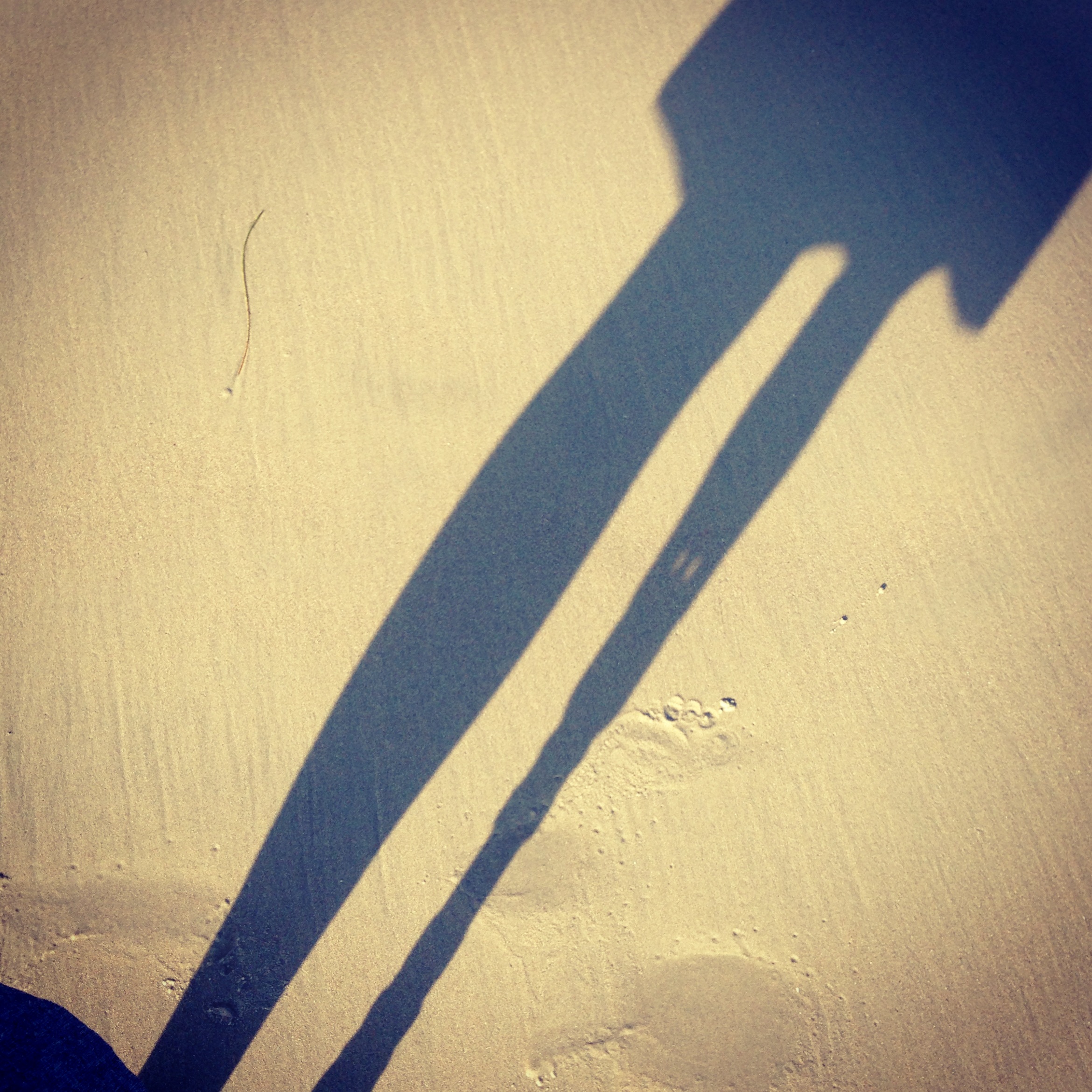
shadow, at the beach

shadow, at the beach


The “ought” of technology

This post from Cyborgology piggybacked nicely on some thoughts that I’ve had recently about the use of technology by faculty at my university.

My thoughts arose from an experience with an adjunct faculty member who came to my office for help in building a robo-graded exam on Blackboard.  In working with her for just a few minutes, I realized that she didn’t know what a web browser was or where software like Blackboard “lived” (she thought that because she created the exam on Blackboard on her laptop, that her students would somehow be remotely logging into her laptop when they took their Blackboard exam).  The upshot of this visit to my office was that she left still fairly confused about Blackboard (my outstanding explanation of servers, notwithstanding), but with a functioning exam that was set to deploy for her students to take at the appointed time.

After pondering my interaction with her for awhile, I began to wonder whether the model of Academic Technology as it works at most universities is flawed.  We automatically give faculty a login to our courseware regardless of whether they’ve attended any trainings, and we provide basic “getting started” tutorials that give faculty just enough click-by-click instructions to begin using it for teaching and assessment within just a few minutes of logging in.  As a result, few have any level of mastery at the technology.  And this approach leads to many problems, which are compounded by the seriousness of administering grades and coursework through a platform that they barely understand and can’t troubleshoot on their own.

As I thought in this vein, it occurred to me that another (perhaps more effective?) way of providing support for Academic Technology would be to do hand-on trainings of the technology first, and then have faculty who would like to use the technology pass a proficiency exam on that software before they receive a login that would deploy their courseware.  While doing that sounds like a bit of a bureaucratic nightmare (and I can just imagine the resistance to attending the training meetings), at least faculty would have a much better sense of what they’re getting themselves into when they start using an LMS for distributing their course content.  In fact, I would say that faculty “ought” to have to have acquired some level of proficiency with the software before they use it, as quoted from the article above:

The ought, I argue, is a carefully curated relationship with technology, one in which the social actor has access, know how, and above all, control.

Because when a technology enters the classroom, it changes teaching and it changes learning.  And instructors ought to be cognizant of this as they’re structuring a learning experience for their students.

But at the same time, I wonder if we ought to pile one more responsibility on the heads of our stretched-thin faculty.  Perhaps the ought should read something more like this: only faculty who have the inclination and motivation to integrate technology ought to use it in the classroom.  Others ought to continue teaching in the ways that they know best.

in praise of rough edges…

On the walk to my office, I pass some spectacular 20th and 21st century art–the gems of Chapman’s collection (including a Lichtenstein, some Rauschenbergs, and several Ruschas).  And just outside my office suite is Mary Addison Hackett’s “Station”

ia-51-b

Yesterday when my daughter came to work with me and encountered the art in the outside hallway for the first time, she lingered longest in front of “Station.”  She marveled at the color.  So I dove a bit into the wormhole of the internet to learn about Hackett, and found her blog.  Fascinating.

I especially enjoyed seeing her posts about the painting that I walk past everyday.

But more than that, I liked her post explaining why she doesn’t tape the edges of her artwork.  Instead, she leaves the canvas bare to reveal the messiness of her process (note: click on the links below to see larger images).

In taking these photos I found myself looking as closely as possible at the edges of the art to see if I could find any of her fingerprints there.  While I didn’t find any smudges that were obviously the marks of her digits, I enjoyed pondering the edges anyways.